Summary of the Article
- The electric M3 concept marks the debut of BMW in Monza Red.
- Natural fiber composites take the place of carbon fiber.
- The production version will showcase angled double yellow lights and stacked white cubes.
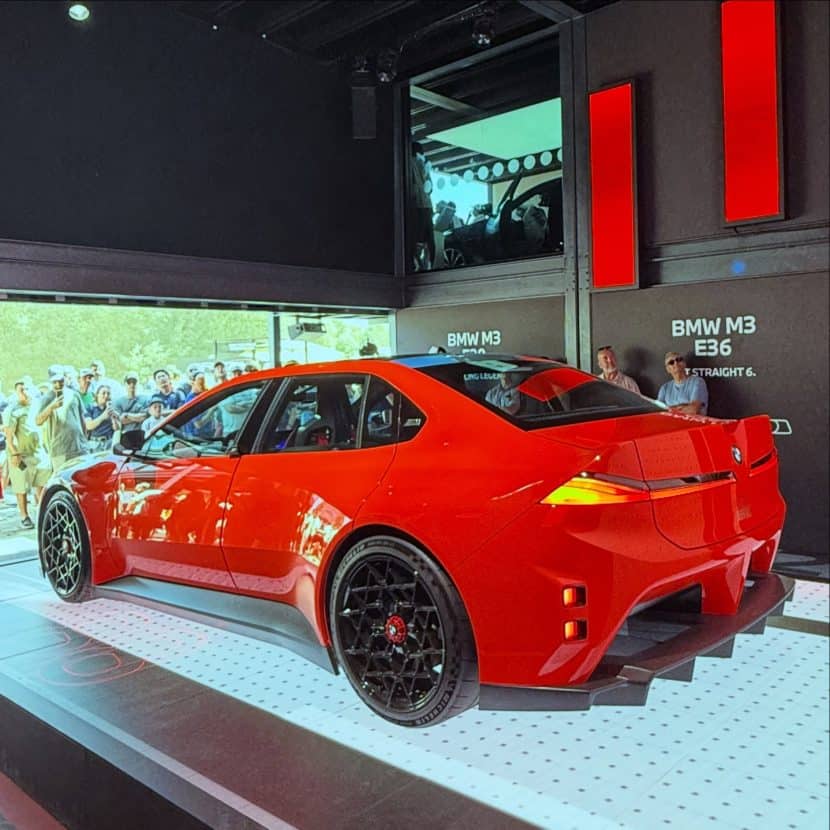
During the Goodwood Festival of Speed, BMW presents not just the i3 First Edition but also the M3 concept. This impressive design offers a peek into what lies ahead. After its introduction at Le Mans, BMW representatives confirmed that the production version will significantly resemble this concept. M CEO Frank van Meel and M design head Oliver Heilmer mentioned that the ZA0 will have an almost identical look.
With its distinctive double yellow lights and striking ducktail spoiler, the design captures attention. Key features include the Track Lights, cube-like stacked white lights at the front bumper corners, as well as stacked red rectangular lights on the rear edges.
BMW has yet to specify particular modifications for the production electric M3, but it is expected that the aerodynamic features might be less aggressive. The M Concept Neue Klasse features a bold rear diffuser not present on camouflaged prototypes of the production version. Likewise, the front splitter is likely to be less emphasized. While center-lock wheels have been featured on certain M models, test vehicles have been spotted utilizing a conventional five-lug setup.
BMW Is Departing from Carbon Fiber
The concept showcases a fresh Monza Red exterior augmented by body components made from natural-fiber composites. The front splitter and rear diffuser are made of this flax-based substance, as well as the mirror covers, hood air outlets, and roof, all developed in partnership with Swiss firm Bcomp. Additionally, the four bucket seats employ this cutting-edge material, decreasing production emissions by 40% without compromising strength or rigidity.
The electric M3 is distinctly broader than the typical i3, although BMW hasn't divulged precise dimensions. For reference, the standard electric 3 Series Sedan measures 1865 millimeters (73.4 inches) in width, while the outgoing combustion-fueled M3 G80 is 1903 millimeters (74.9 inches) wide.
This electric M3 will enhance the model range instead of serving as a replacement, as a new gas-powered M3 is anticipated to debut in 2028 as the G84. The six-cylinder version will keep much of the ZA0's design, adding a quad exhaust and larger air intakes for its twin-turbocharged 3.0-liter powertrain. Both models are predicted to come with wagon options, though this hasn't been officially verified.
When the ZA0 launches next year, it is projected to feature a quad-motor configuration producing around 800-850 horsepower. Drivers will have the ability to disable the front motors for a rear-wheel-drive feel and can use simulated gears, which BMW categorizes as “essential.” The electric M3 will be equipped with a dedicated lithium-ion battery pack featuring over 100 kWh of usable energy, although its range is expected to be lower than the i3’s impressive 906-kilometer (563-mile, WLTP) rating.
While numerous aspects of BMW’s first fully electric M vehicle remain undisclosed, the excitement continues to rise.
Images: <a href="https://www.bimmertoday.de/2026/07/11
Summary of the Article
- The electric M3 concept marks the debut of BMW in Monza Red.
- Natural fiber composites take the place of carbon fiber.
- The production version will showcase angled double yellow lights and stacked white cubes.
During the Goodwood Festival of Speed, BMW presents not just the i3 First Edition but also the M3 concept. This impressive design offers a peek into what lies ahead. After its introduction at Le Mans, BMW representatives confirmed that the production version will significantly resemble this concept. M CEO Frank van Meel and M design head Oliver Heilmer mentioned that the ZA0 will have an almost identical look.
With its distinctive double yellow lights and striking ducktail spoiler, the design captures attention. Key features include the Track Lights, cube-like stacked white lights at the front bumper corners, as well as stacked red rectangular lights on the rear edges.
BMW has yet to specify particular modifications for the production electric M3, but it is expected that the aerodynamic features might be less aggressive. The M Concept Neue Klasse features a bold rear diffuser not present on camouflaged prototypes of the production version. Likewise, the front splitter is likely to be less emphasized. While center-lock wheels have been featured on certain M models, test vehicles have been spotted utilizing a conventional five-lug setup.
BMW Is Departing from Carbon Fiber
The concept showcases a fresh Monza Red exterior augmented by body components made from natural-fiber composites. The front splitter and rear diffuser are made of this flax-based substance, as well as the mirror covers, hood air outlets, and roof, all developed in partnership with Swiss firm Bcomp. Additionally, the four bucket seats employ this cutting-edge material, decreasing production emissions by 40% without compromising strength or rigidity.
The electric M3 is distinctly broader than the typical i3, although BMW hasn’t divulged precise dimensions. For reference, the standard electric 3 Series Sedan measures 1865 millimeters (73.4 inches) in width, while the outgoing combustion-fueled M3 G80 is 1903 millimeters (74.9 inches) wide.
This electric M3 will enhance the model range instead of serving as a replacement, as a new gas-powered M3 is anticipated to debut in 2028 as the G84. The six-cylinder version will keep much of the ZA0’s design, adding a quad exhaust and larger air intakes for its twin-turbocharged 3.0-liter powertrain. Both models are predicted to come with wagon options, though this hasn’t been officially verified.
When the ZA0 launches next year, it is projected to feature a quad-motor configuration producing around 800-850 horsepower. Drivers will have the ability to disable the front motors for a rear-wheel-drive feel and can use simulated gears, which BMW categorizes as “essential.” The electric M3 will be equipped with a dedicated lithium-ion battery pack featuring over 100 kWh of usable energy, although its range is expected to be lower than the i3’s impressive 906-kilometer (563-mile, WLTP) rating.
While numerous aspects of BMW’s first fully electric M vehicle remain undisclosed, the excitement continues to rise.