
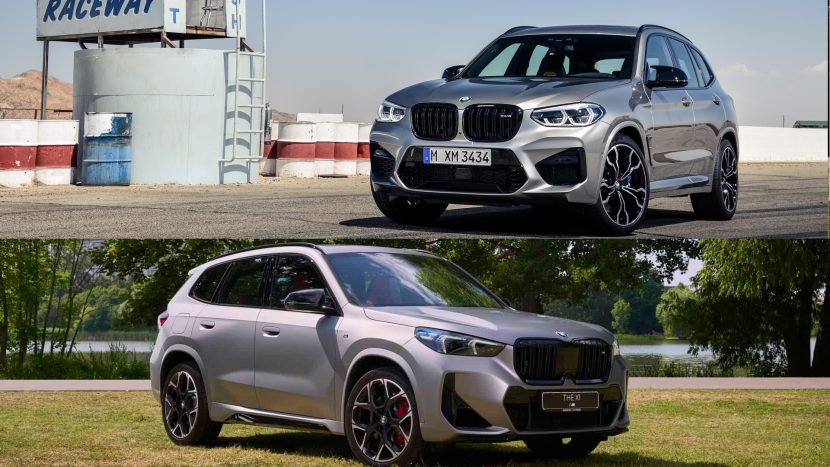
The 2027 BMW X1 is a perfectly sensible SUV. And for $44,550 after destination, it’s one of BMW’s most affordable options. But taking nearly $45,000 into the used marketplace puts things in a different light. You can snag a used X3 M for around the same price as that new X1. So, instead of tinkering with iDrive 9, you could be ripping around in the most powerful gas-powered X3 BMW ever made. As with everything, there’s trade-offs. But they just might be worth it.
What $44,550 Gets You in a New BMW X1
BMW asks $43,200 for the 2027 X1 xDrive28i, and the $1,350 destination makes up the rest of the sticker price. Fortunately, BMW includes xDrive even on the least expensive X1 it sells here in the United States. A turbocharged 2.0-liter four-cylinder sends 241 horsepower and 295 lb-ft of torque through a seven-speed dual-clutch transmission. BMW quotes 6.2 seconds to 60 mph, plenty quick for something you bought primarily because it fits both the family and the parking situation.
The X1 makes particularly good use of the space behind its front seats. You get 25.7 cubic feet of cargo room with the rear seats up and 57.2 with them folded. Better yet, the rear bench splits 40/20/40. Drop the middle section and you can take a pair of skis and two rear passengers without making anyone sit shoulder to shoulder. Up front, heated seats, wireless Apple CarPlay and Android Auto, and a 10.7-inch touchscreen all come standard.
Where the X1 starts to cede its advantage is the options list. Premium sound—Harman Kardon in this case—is another $650. Sport seats cost $400. And if the whole reason you’re browsing used M cars is that you’d like a little more motor, BMW has an answer in the same showroom. The 312-horsepower X1 M35i starts at $53,750 delivered, and it relies on a turbocharged four-cylinder largely similar to the base car’s. That’s also $9,200 more than the xDrive28i, which quickly explains how one might end browsing used car listings in the first place.
The X3 M Got the M3’s Engine First
The F97 X3 M has an interesting claim to fame. BMW chose it and the X4 M to introduce the S58, the twin-turbocharged 3.0-liter straight-six that would go on to power the G80 M3. Even the standard X3 M made 473 horsepower. The Competition brought that to 503 and would happily rev to 7,200 rpm. At the price point we’re searching at, you can choose from Competition and non-Competition models.
What you won’t have much room on is model year; almost all of the cars we found are 2021 or earlier models. BMW gave the X3 M a mid-lifecycle refresh, or LCI, in 2022. The LCI brought increased torque (442 lb-ft rose to 479 lb-ft) and several exterior tweaks. Inside, BMW introduced iDrive 7, which included a new gauge cluster and climate controls. Luckily, horsepower went unchanged. And power is only the tip of the iceberg. The X3 M came loaded with goodies designed to make the family hauler really haul, including an adaptive suspension, 20-inch wheels, and M xDrive.
There are practical reasons to opt for an X3 M over a new X1, too. Although, admittedly, most of these specs aren’t exactly locked behind the twin-turbo inline-six variant. The X3 M offers 28.7 cubic feet of cargo space with the seats in place; that grows to 62.7 with the seats folded. Those sport seats and fancy sound system you would spend extra on in the X1? Standard fare with the X3 M (as one might expect on a $70,000 when-new vehicle).
X3 M, the Obvious X1 Alternative?
Incredible horsepower and excellent features are the obvious pluses here. But of course, snagging an X3 M for around $45,000 does have its drawbacks. As mentioned, you’re primarily looking at pre-LCI cars, which means the newest X3 M you’re buying is still from 2021, five years old at this point. Most of these cars will have moderate mileage on them, too; around 60,000 miles or so. Any five-year old car could have some problems; of course, with the X3 M, you’re inheriting problems from a $70k+ super SUV.
Though the S58 engine has proved fairly reliable since its debut, the fact remains: the X3 M is quite a bit more expensive to live with than the X1. Tires, oil, and brakes are just some of the consumables that will undoubtedly cost more (in some cases several hundred dollars more) for the X3 M than they would on the X1. On the off chance something does break, it’ll cost you: most S58 (and indeed, X3 M) parts are burdened with the “M tax,†as they are unique to M models. At 60,000 miles or so, you’re looking at some routine items that previous owners likely deferred, including diff/transmission/transfer case fluid flushes and spark plugs. It can add up quick. The X3 M will likely be more expensive to insure, too, and we somehow doubt you’ll see the kind of fuel economy you would with an X1.
The price of admission is around the same. But keeping up after the point of sale is a very different story. That said: if you can swing it, why not? The X3 M is a pretty unique slice of BMW history—especially while there is not yet a true successor. We’re not saying the X3 M is going to work for every prospective X1 buyer. But it’s hard to say no to 500 horsepower, isn’t it?
First published by https://www.bmwblog.com