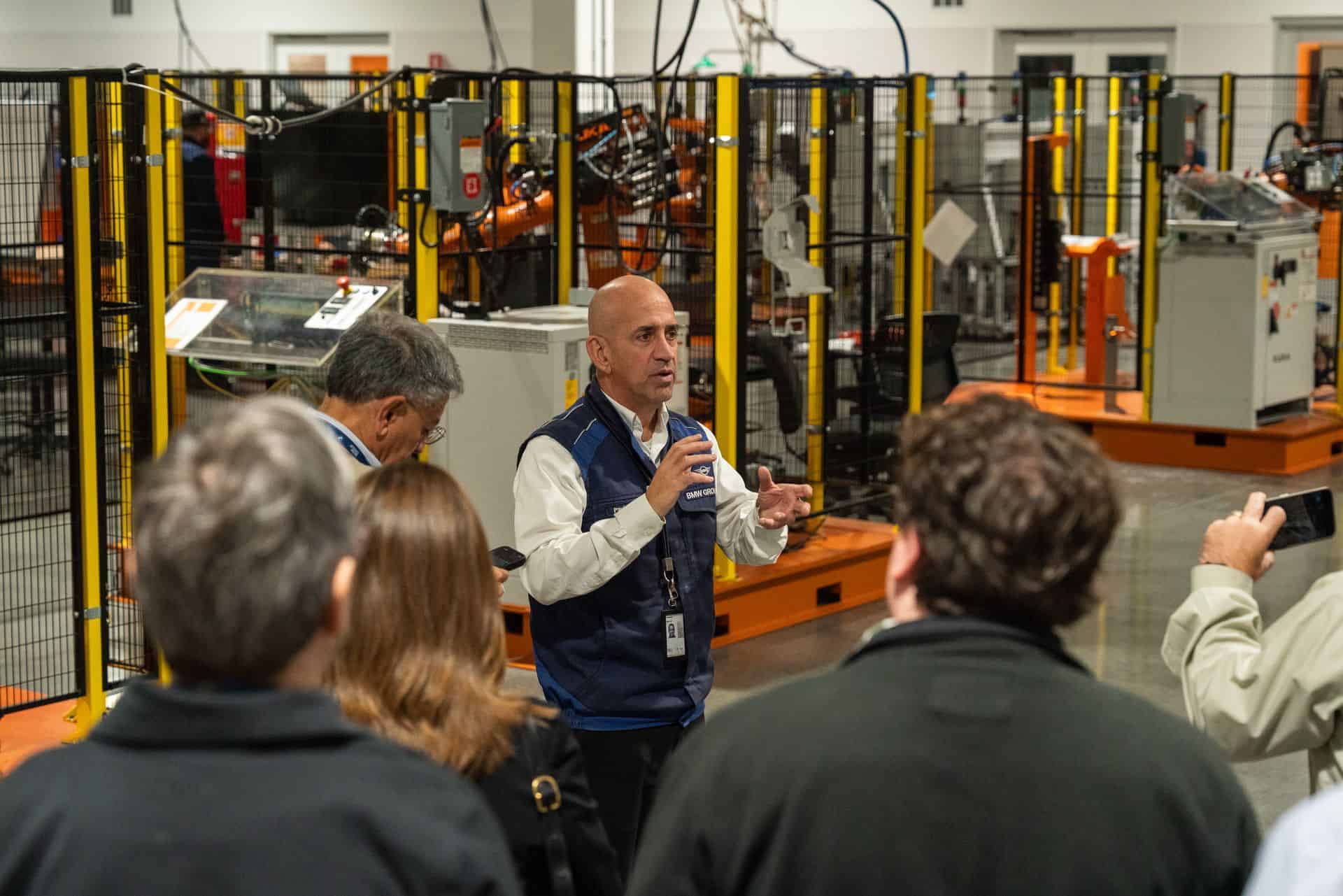
BMW cut the ribbon on Plant Woodruff, its first U.S. battery assembly plant, on November 13, closing its two-day “Beyond the Machine” program. The night before, at a talk-show-style event in downtown Greenville, a new University of South Carolina study put BMW’s annual economic impact on the state at $36.1 billion, up from $26.7 billion in 2022. We followed the program through Plant Spartanburg, its training center and Woodruff. Most of it dealt with what sits behind a plant that can build 450,000 vehicles a year: the steel inside the new BMW iX5, the AI that moves parts and cars through the factory, and the people trained to run it.
What The New University Of South Carolina Study Found
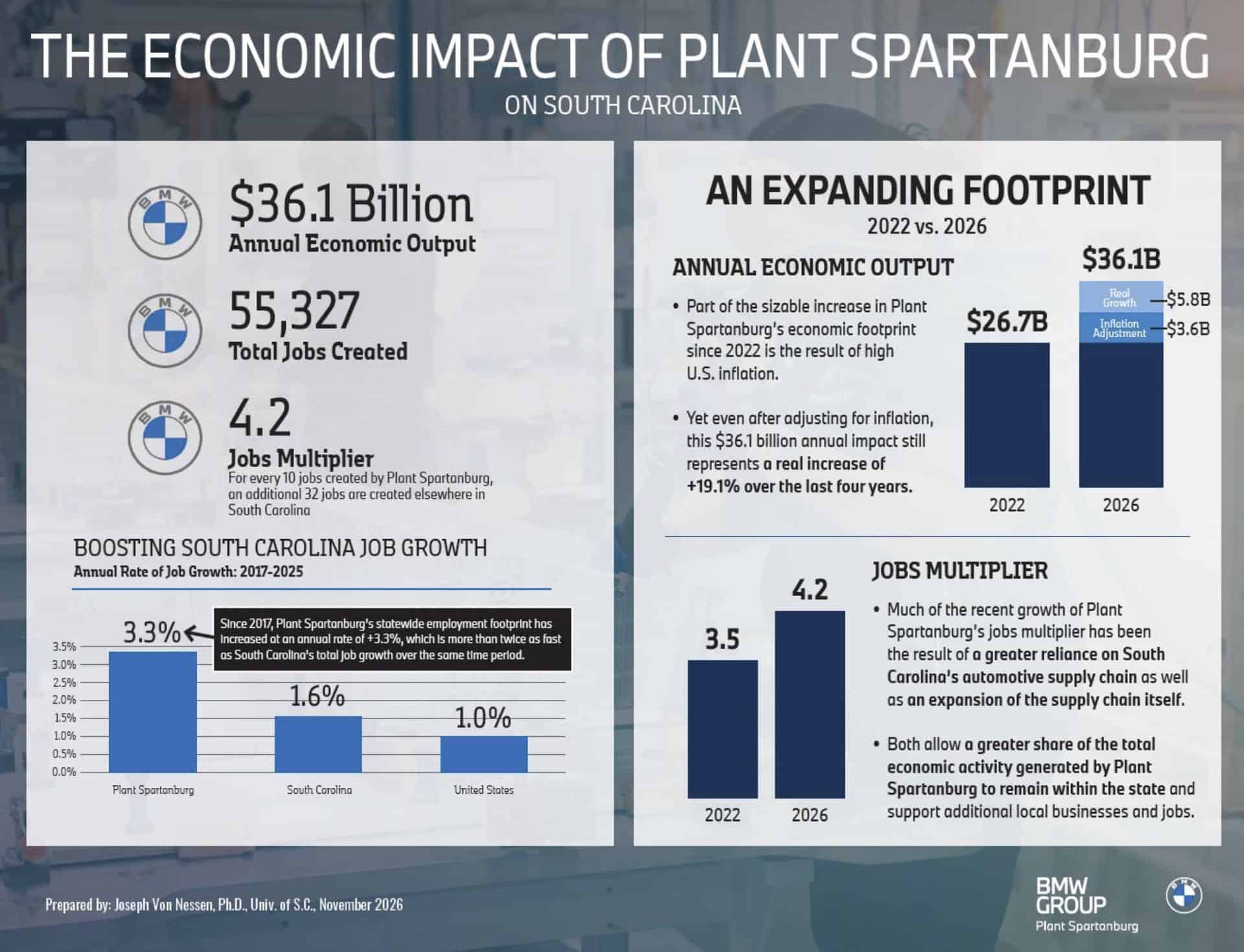
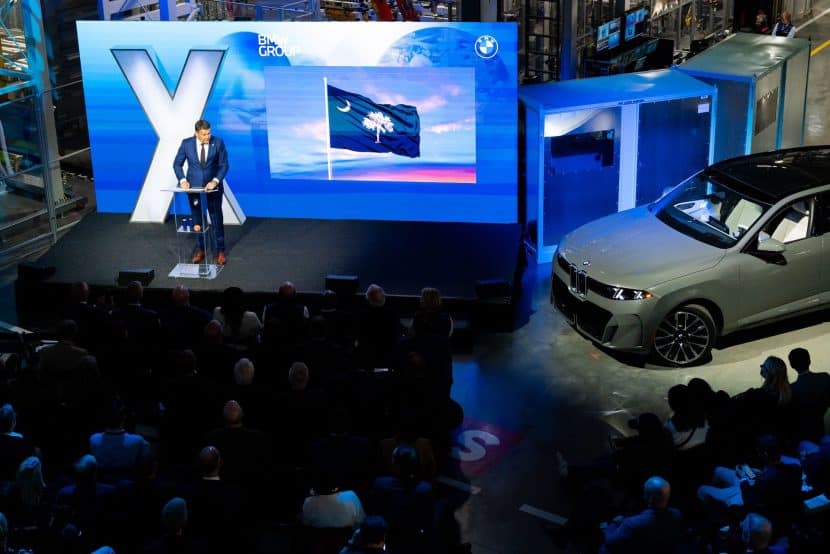
Economist Joseph Von Nessen of USC’s Darla Moore School of Business presented the findings on stage with BMW Manufacturing CEO Robert Engelhorn. WYFF anchor Jane Robelot hosted the evening, and the mayors of Greenville, Spartanburg, Greer and Woodruff took part. The study credits BMW with supporting 55,327 jobs in South Carolina and $4.4 billion in wages and salaries. The figure Von Nessen singled out was the jobs multiplier of 4.2: for every 10 jobs at BMW Manufacturing, another 32 exist elsewhere in the state. He put the average for South Carolina manufacturers at 1.7, and said the growth since 2022 works out to nearly 20 percent after inflation.
Plant Spartanburg’s statewide employment footprint grew 3.3 percent a year on average from 2017 to 2025, more than twice the rate for South Carolina as a whole. A nationwide version of the study is due in early 2027.
Exports are a big part of that math. Engelhorn said Spartanburg builds about 1,500 vehicles a day and ships half of its output to 120 countries, which has made BMW the largest U.S. car exporter by value for more than a decade. He also told the audience that BMW stands for free trade. At the same time, BMW is reportedly pointing to the Spartanburg expansion as it presses the Trump administration for tariff relief.
How Nucor’s Recycled Steel Lowers The iX5’s Carbon Footprint
The study counts more than 400 U.S. suppliers for Plant Spartanburg, and steel shows why BMW wants them close. BMW imports only about a third of the steel it needs in South Carolina, said Wayne Copeland, who leads steel purchasing for BMW’s plants in the Americas. Spartanburg goes through about 400,000 metric tons a year. Roughly 10 percent feeds BMW’s own press shop next to the plant, which opened two years ago and stamps about 10,000 parts a day, and the rest goes to outside stampers.
Steel is about 35 percent of the iX5’s material. In a typical midsize electric SUV, BMW says, steel accounts for 18 percent of supply-chain CO2, behind battery cells at 41 percent. About half of the iX5’s flat steel comes from electric arc furnaces that run largely on scrap, and the SUV as a whole carries about 2,080 pounds of secondary material, roughly a third of the vehicle.
Nucor, the largest U.S. steelmaker, has been awarded about 27,000 tons of X5 steel from its mill in Berkeley County near Charleston, covering roughly 100 body-in-white parts. Nucor says its arc-furnace steel averages 0.77 tons of greenhouse gas per ton, against 2.32 tons for coal-based blast-furnace steel, and everything BMW buys from it is the Econic RE grade made with renewable electricity. Nucor’s team also pushed back on the idea that scrap-based mills can’t make advanced high-strength grades: its first steel for BMW was a complex-phase grade, and it is now developing 1180 multiphase steel for series production.
The closed loop is the clever part. Since late 2024, scrap from BMW’s press shop has gone back to the Berkeley mill, about 17,000 gross tons in the program’s first year and roughly 20,000 tons expected this year, to return as steel for future X5s. Steel coils are only a sliver of what reaches Spartanburg, though: about 3.3 million parts arrive every day, in more than 1,000 truckloads.
How BMW Cut A Logistics Decision From Eight Minutes To 45 Seconds
Those parts come from about 750 tier-one supplier sites in North America, roughly half of them in the U.S. BMW tripled that base between 2015 and 2024 and expects more than 850 next year. Thirty-eight suppliers now sit within 20 miles of the plant, and when chips ran short during the semiconductor crisis, BMW flew them into Greenville-Spartanburg International Airport to keep the line moving.
Deciding which of those trailers to unload next used to mean checking 15 separate systems, about eight minutes per trailer on a line that runs a 90-second takt time. BMW’s logistics and IT teams built a tool with AWS called Titan that pulls those sources into one view and boils more than 30 parameters down to a single score per container. The decision now takes 45 seconds.
The team used coding agents such as GitHub Copilot to build Titan in a few months, against the year to 18 months that enterprise software of this kind usually takes. BMW also pulls associates off their regular jobs for three-day AI hackathons to automate their own processes. The same approach has reached the boardroom. BMW said AI agents now take part in board-level decisions. One, nicknamed Mr. Flexibility, works through questions like what it would take to build 10,000 more iX3s in 2028 across production, suppliers and logistics, in real time instead of in rounds of back-and-forth between departments.
When Will New BMWs Start Driving Themselves Out Of Spartanburg?
In 2027, when Spartanburg becomes the fifth BMW plant to run Automated Driving In-Plant, the system that lets new cars leave the end of the assembly line with nobody behind the wheel. Titan manages what arrives at the docks, and this handles what leaves the line.
The cars carry no extra hardware. Lidar sensors mounted around the plant track them, and cloud software from Swiss partner Embotech plans each route and steers the car through its own drive-by-wire controls, whatever options it was built with. BMW has already logged more than one million driverless moves at Dingolfing, Leipzig, Regensburg and MINI Plant Oxford, about 3,500 a day. In Spartanburg, BMW presented a first use case that moves finished cars toward shipping, with two more coming next year, including one deeper inside production.
Embotech is also a BMW i Ventures portfolio company. The venture arm, which presented at the event, manages $1.1 billion across three funds and has backed more than 100 startups. Its current $300 million fund invests in North America, Europe and Israel.
A Clip-On Camera That Checks Quality Inspections In Real Time
Not every AI project comes from a startup. BMW’s in-house IT research team in Spartanburg, which built a customer chatbot with OpenAI in 2021 before ChatGPT existed, showed a physical AI project it calls spatial human amplification. A small camera clips onto an associate’s safety glasses and feeds a video model running locally on a phone, which ticks off each inspection step (fuel flap, sun visor, displays) as the worker performs it. Inspectors currently trigger each check by hand, for hundreds of cars a day.
Working with academic partners including MIT, the team found the model can learn a new action from about 20 videos. At an end-of-line inspection station in Spartanburg it reached about 98 percent accuracy, and 500 videos of 5 Series production from another BMW plant scored around 99 percent. In the paint shop, the camera on the glasses watches associates fit silicone caps, a critical step no fixed camera can see. The team also worked with the Savannah College of Art and Design on fitting cameras and microphones into a future smart uniform, and has since handed the project to BMW headquarters for a wider rollout.
The same kind of video AI is already live at dealers. In Brazil and Mexico, service technicians film the work on every customer’s car, more than 15,000 videos a month. Through its Startup Garage, BMW found Twelve Labs, whose model now grades all of them for clarity and correct terminology. BMW uses the scores for a technician recognition program that used to run on opinion.
Can BMW Train Enough Technicians To Build Its Electric X Models?
All of this still needs people who know when not to trust the machine. “AI is the ratchet,” said Paul Sinanian, who heads talent and training at Plant Spartanburg, comparing an unchecked AI answer to running a bolt down and walking away without seeing whether it cross-threaded. He has cut the apprentice curriculum from 100 percent technical to 75 percent to make room for teamwork and resilience.
The core of his pipeline is BMW Scholars, a two-year apprenticeship based on the German model. BMW pays for an associate degree at Greenville Tech, Spartanburg Community College, Tri-County Tech or Piedmont Tech while students work up to 30 hours a week, then hires them. It has about 130 apprentices today, after falling to five during COVID. A high school version that began with three students now has 51, and a program launching in January will take adults without a high school diploma through a GED and into a production job within 12 months.
The outreach now starts much earlier. BMW brings guidance counselors and teachers to the plant before eighth grade, when South Carolina students pick a career cluster, and it hosts FIRST Robotics competitions that reach kids as young as fourth grade. Sinanian’s case for starting that early: the average licensed electrician in the U.S. is 57, he said. His team also wrote the change that lets companies use the state’s Retrain SC funds for reskilling, and it is introducing a youth apprenticeship bill in January.
What Plant Woodruff Means For U.S.-Built Electric BMWs
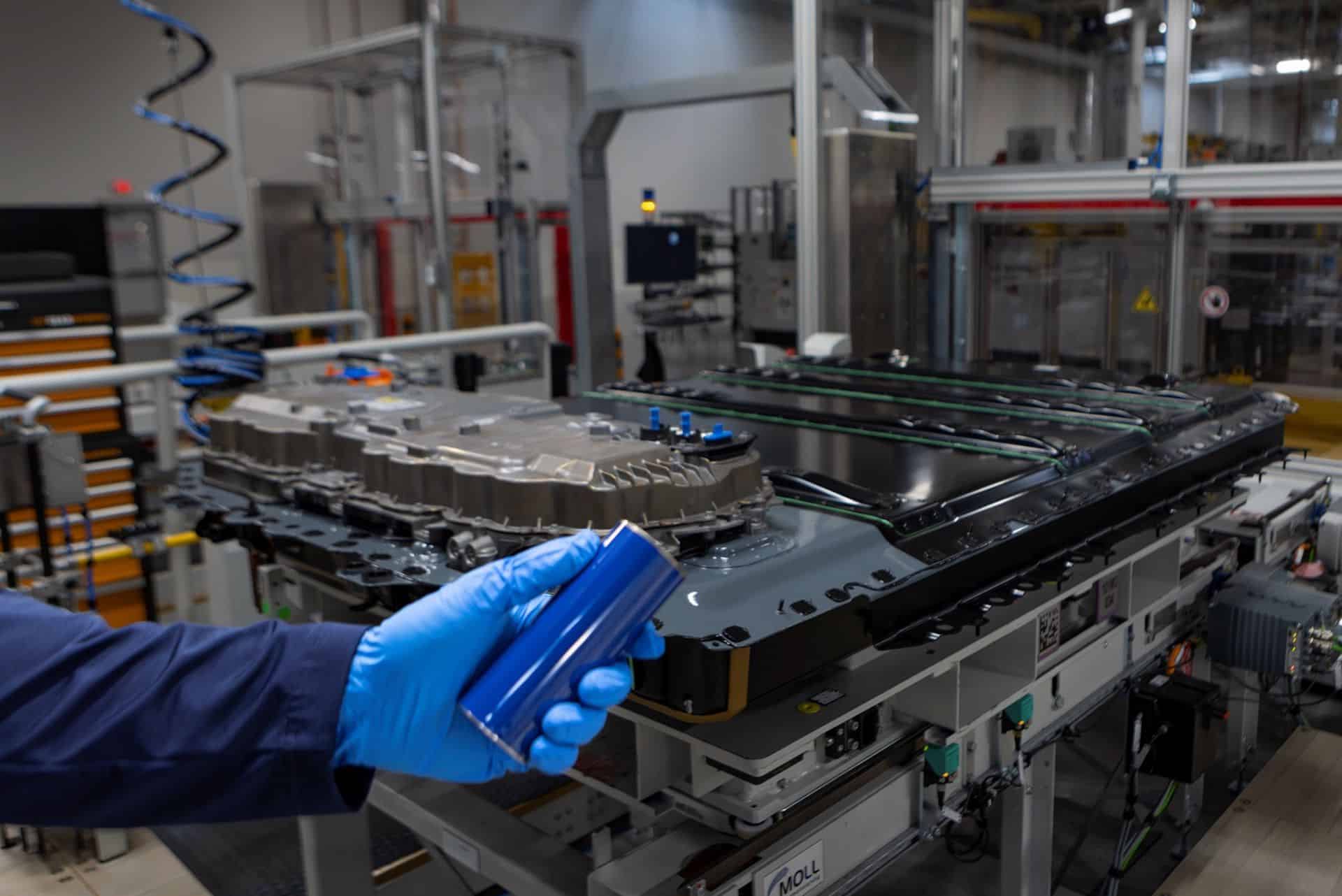
Some of those people are already at Plant Woodruff, built on a former peach farm 15 miles from Spartanburg. About 300 employees, who trained in virtual reality before production began, work alongside 250 robots building Gen6 high-voltage packs in more than one million square feet. Gov. Henry McMaster joined BMW executives for the opening. We covered the iX5’s 144-kWh pack and where its cells come from in a separate story.
iX5 assembly has now started in Spartanburg at about 70 a day, making it the first fully electric BMW built in the U.S. Until now, every electric BMW sold here was imported. BMW plans at least six fully electric models in the U.S. by 2030, but it has reportedly told suppliers to expect 60,000 EVs in 2027, down from an earlier forecast of 100,000. Wittmann still called electromobility BMW’s most important growth area, and in early November BMW announced additional battery cell partnerships, including one with LG Energy Solution for the U.S.
The X5 is where this all started. The first one left Spartanburg in 1999, and BMW says it was also its first series car built with CO2-reduced steel. Twenty-seven years later, the same nameplate is the first electric BMW built in America, with a battery from a former peach farm down the road and parts scheduled by AI. The badge on the tailgate is the same, but almost everything behind it has changed.
First published by https://www.bmwblog.com