Article Summary
- Mercedes-AMG has revealed plans to bring back new V8 models by late 2026, starting with SUVs and subsequently introducing the CLE 63 Coupe.
- The C-Class will shift to a six-cylinder AMG variant, marking the conclusion of V8 availability in Mercedes' compact performance range.
- Conversely, BMW's G90 M5 retains its V8, featuring a 4.4-liter twin-turbo engine combined with an electric motor for a total output of 717 hp, setting the stage for renewed competition as AMG re-enters this segment.
Mercedes-AMG is set to reintroduce V8 engines into its lineup, with fresh models anticipated to arrive by the close of 2026. AMG CEO Michael Scheibe has announced that the division is recommitting to combustion engines, reversing its prior trend of phasing out V8s from its offerings.
SUVs will be the initial recipients of the new V8, followed by additional models. The C-Class will not take part in this rollout, as it plans to transition to a six-cylinder AMG variant, officially signaling the end of V8s in Mercedes' compact performance lineup.
The forthcoming engine is expected to be a more powerful derivative of the 4.0-liter turbo V8 currently employed in the S-Class and GLS, which generates 530 hp. Reports suggest that the CLE 63 Coupe will be the first to showcase this engine, with a high-performance Mythos edition expected thereafter. The GLE 63 S and GLS 63 already utilize this engine family, delivering up to 603 hp, which will set the standard for the remaining lineup.
Some may recall that AMG had focused on downsizing, with the four-cylinder hybrid C63 facing criticism from dedicated customers, prompting the company to rethink this approach.
BMW Retains Its V8
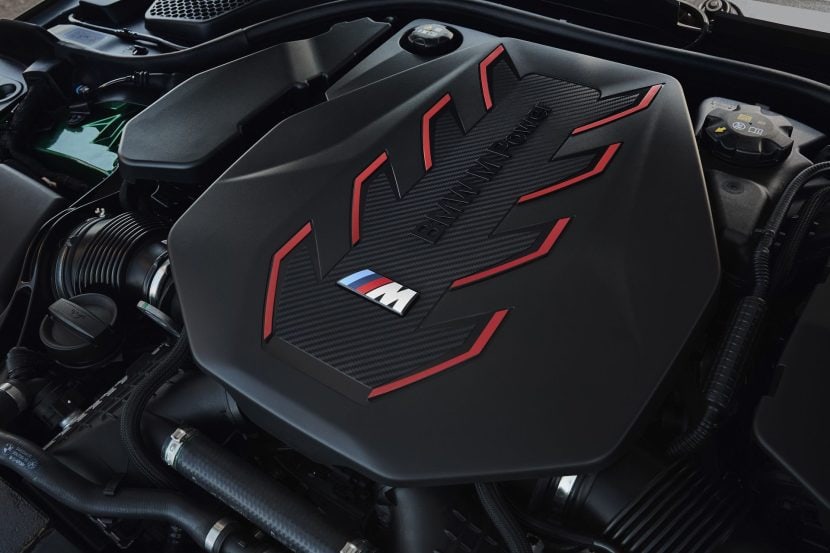
While Mercedes explored various engine configurations, BMW has maintained its V8, opting for hybridization rather than elimination. The G90 M5 boasts a 4.4-liter twin-turbo V8 teamed with an electric motor, providing a combined output of 717 hp. The V8 remains standard in the X5 M, X6 M, and X7 M60i. This alternative strategy—utilizing hybrid-enhanced power rather than a complete transition—has allowed BMW to sustain its V8 presence, while Mercedes may be stepping back from this sector.
This differentiation is vital for consumers in this market, as those comparing the G90 M5 to the E63 or the X5 M to the GLE 63 are largely concentrated on engine performance instead of infotainment features. The engine is a crucial element of the sales draw.
It’s plausible that some AMG fans, disappointed by the C63's shift to a four-cylinder hybrid, may have turned to BMW instead. While sales statistics do not explicitly track losses related to engine configurations, a variety of factors influence buying choices, including design, leasing options, dealer interactions, and brand loyalty. Narrowing the dialogue to engine type alone would be simplistic, yet it mirrors the ongoing discourse among enthusiasts.
Competition Rekindled
With AMG's V8 now confirmed, the debate shifts from who has forsaken combustion to which V8 will come out on top. Mercedes and BMW have a history of rivalry, particularly highlighted during the E63 and M5 clashes of the 2010s, and it is poised to reignite, though each brand will tackle it with a different strategy. BMW's V8 stands robust and hybrid-supportive at an impressive 717 hp, whereas AMG returns with a more conventional combustion setup in some models, likely attracting buyers who might perceive the M5's hybrid weight and intricacies as hindrances.
This story extends beyond just Mercedes and BMW. Stellantis has brought back the Hemi after it was phased out, and Lamborghini continues to champion its naturally aspirated V8 engines.
Article Summary
- Mercedes-AMG has revealed plans to bring back new V8 models by late 2026, starting with SUVs and subsequently introducing the CLE 63 Coupe.
- The C-Class will shift to a six-cylinder AMG variant, marking the conclusion of V8 availability in Mercedes’ compact performance range.
- Conversely, BMW’s G90 M5 retains its V8, featuring a 4.4-liter twin-turbo engine combined with an electric motor for a total output of 717 hp, setting the stage for renewed competition as AMG re-enters this segment.
Mercedes-AMG is set to reintroduce V8 engines into its lineup, with fresh models anticipated to arrive by the close of 2026. AMG CEO Michael Scheibe has announced that the division is recommitting to combustion engines, reversing its prior trend of phasing out V8s from its offerings.
SUVs will be the initial recipients of the new V8, followed by additional models. The C-Class will not take part in this rollout, as it plans to transition to a six-cylinder AMG variant, officially signaling the end of V8s in Mercedes’ compact performance lineup.
The forthcoming engine is expected to be a more powerful derivative of the 4.0-liter turbo V8 currently employed in the S-Class and GLS, which generates 530 hp. Reports suggest that the CLE 63 Coupe will be the first to showcase this engine, with a high-performance Mythos edition expected thereafter. The GLE 63 S and GLS 63 already utilize this engine family, delivering up to 603 hp, which will set the standard for the remaining lineup.
Some may recall that AMG had focused on downsizing, with the four-cylinder hybrid C63 facing criticism from dedicated customers, prompting the company to rethink this approach.
BMW Retains Its V8
While Mercedes explored various engine configurations, BMW has maintained its V8, opting for hybridization rather than elimination. The G90 M5 boasts a 4.4-liter twin-turbo V8 teamed with an electric motor, providing a combined output of 717 hp. The V8 remains standard in the X5 M, X6 M, and X7 M60i. This alternative strategy—utilizing hybrid-enhanced power rather than a complete transition—has allowed BMW to sustain its V8 presence, while Mercedes may be stepping back from this sector.
This differentiation is vital for consumers in this market, as those comparing the G90 M5 to the E63 or the X5 M to the GLE 63 are largely concentrated on engine performance instead of infotainment features. The engine is a crucial element of the sales draw.
It’s plausible that some AMG fans, disappointed by the C63’s shift to a four-cylinder hybrid, may have turned to BMW instead. While sales statistics do not explicitly track losses related to engine configurations, a variety of factors influence buying choices, including design, leasing options, dealer interactions, and brand loyalty. Narrowing the dialogue to engine type alone would be simplistic, yet it mirrors the ongoing discourse among enthusiasts.
Competition Rekindled
With AMG’s V8 now confirmed, the debate shifts from who has forsaken combustion to which V8 will come out on top. Mercedes and BMW have a history of rivalry, particularly highlighted during the E63 and M5 clashes of the 2010s, and it is poised to reignite, though each brand will tackle it with a different strategy. BMW’s V8 stands robust and hybrid-supportive at an impressive 717 hp, whereas AMG returns with a more conventional combustion setup in some models, likely attracting buyers who might perceive the M5’s hybrid weight and intricacies as hindrances.
This story extends beyond just Mercedes and BMW. Stellantis has brought back the Hemi after it was phased out, and Lamborghini continues to champion its naturally aspirated V8 engines.