Today marks a notable point in automotive history. Starting January 1, 2026, the ALPINA brand has officially become part of BMW Group, ending 61 years of autonomy by the Bovensiepen family. Founded in 1965 as a small tuning firm in Buchloe, Germany—originally focused on carburetors and cylinder heads—ALPINA has evolved into one of the most respected car manufacturers worldwide, acknowledged by the German Federal Motor Transport Authority as an independent car maker since 1983.
BMW took over ALPINA in March 2022, yet honored a multi-year transition agreement enabling the brand to operate independently until the close of 2025. Now, as ALPINA transitions into BMW ALPINA—a luxury performance division within the BMW Group, alongside M, MINI, and Rolls-Royce—it is the perfect opportunity to celebrate the iconic vehicles that defined ALPINA’s independent era.
These cars were not simply enhanced BMWs. ALPINA vehicles featured unique VINs, warranties, and a distinct philosophy: to distinguish BMWs—not merely to boost performance—but to refine them, cultivate exclusivity, and frequently deliver a more practical driving experience compared to their M Division equivalents.
Here are five of the most legendary ALPINA cars ever created.
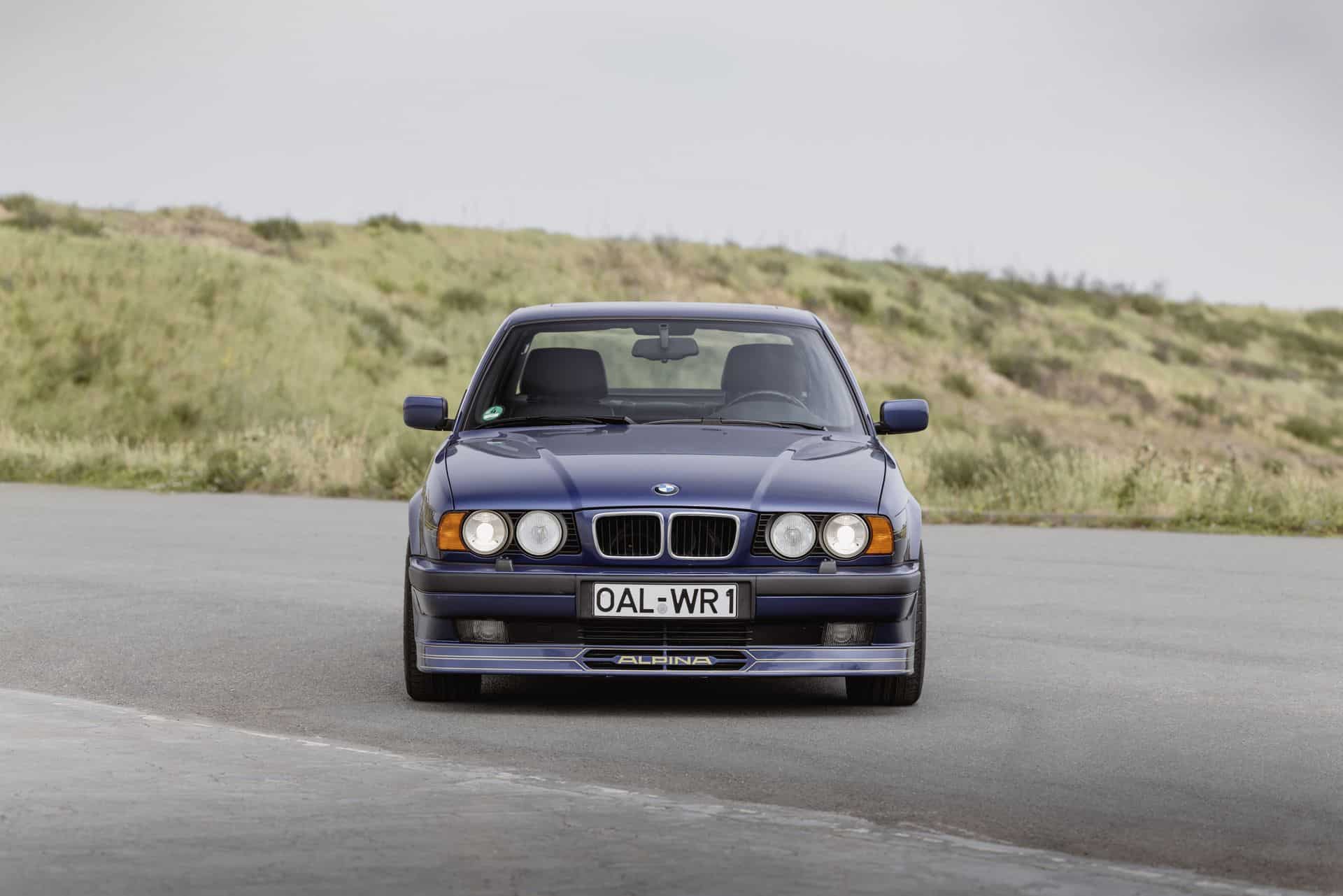
1. ALPINA B10 Bi-Turbo (E34): The World’s Fastest Sedan
1989-1994 | 507 Units Produced
The B10 Bi-Turbo exemplifies ALPINA’s engineering excellence. Debuting at the 1989 Geneva Motor Show, it asserted itself as the fastest production sedan in the world.
Built on the BMW 535i platform, ALPINA devoted substantial resources to create what many considered “the finest 4-door in the world.” The overhaul was comprehensive: ALPINA fully disassembled the M30 inline-six, fitted forged Mahle pistons, added twin Garrett T25 water-cooled turbochargers, and included a Bosch variable boost control system that could be adjusted by the driver from 0.4 to 0.8 bar.
The result? An impressive 360 horsepower at 6,000 rpm and 520 Nm of torque—allowing the B10 Bi-Turbo to sprint from 0-100 km/h in just 5.6 seconds and achieve a top speed surpassing 290 km/h (180 mph). Notably, it equaled the Ferrari Testarossa in straight-line performance. In a remarkable test by the German publication Sport Auto, the B10 outpaced the Italian supercar off the line, reaching 100 km/h half a second quicker.
However, the B10 Bi-Turbo was not just about speed. It was equipped with enhanced Bilstein suspension, automatic load-leveling at the rear to mitigate excessive camber over 170 mph, a custom-developed Getrag 5-speed manual gearbox, and a 25-percent limited-slip differential. Inside, Recaro sport seats clad in ALPINA fabric, a leather-wrapped Momo steering wheel, and polished wood accents created an environment of understated sophistication unmatched by any M5.
Despite being nearly twice the price of an E34 M5 at 146,800 DM, the B10 Bi-Turbo emerged as ALPINA’s top-selling model at that time. Production wrapped up in August 1994 when BMW discontinued the M30 engine; the final 50 M30 blocks were exclusively assigned to ALPINA to complete the production run.
Today, the B10 Bi-Turbo is widely viewed as ALPINA’s crowning achievement—a car that illustrated how a small independent manufacturer could compete with supercars while offering four-door practicality and BMW durability.
2. ALPINA B7 Turbo Coupé (E24): The Autobahn Missile
<h
Today marks a notable point in automotive history. Starting January 1, 2026, the ALPINA brand has officially become part of BMW Group, ending 61 years of autonomy by the Bovensiepen family. Founded in 1965 as a small tuning firm in Buchloe, Germany—originally focused on carburetors and cylinder heads—ALPINA has evolved into one of the most respected car manufacturers worldwide, acknowledged by the German Federal Motor Transport Authority as an independent car maker since 1983.
BMW took over ALPINA in March 2022, yet honored a multi-year transition agreement enabling the brand to operate independently until the close of 2025. Now, as ALPINA transitions into BMW ALPINA—a luxury performance division within the BMW Group, alongside M, MINI, and Rolls-Royce—it is the perfect opportunity to celebrate the iconic vehicles that defined ALPINA’s independent era.
These cars were not simply enhanced BMWs. ALPINA vehicles featured unique VINs, warranties, and a distinct philosophy: to distinguish BMWs—not merely to boost performance—but to refine them, cultivate exclusivity, and frequently deliver a more practical driving experience compared to their M Division equivalents.
Here are five of the most legendary ALPINA cars ever created.
1. ALPINA B10 Bi-Turbo (E34): The World’s Fastest Sedan
1989-1994 | 507 Units Produced
The B10 Bi-Turbo exemplifies ALPINA’s engineering excellence. Debuting at the 1989 Geneva Motor Show, it asserted itself as the fastest production sedan in the world.
Built on the BMW 535i platform, ALPINA devoted substantial resources to create what many considered “the finest 4-door in the world.” The overhaul was comprehensive: ALPINA fully disassembled the M30 inline-six, fitted forged Mahle pistons, added twin Garrett T25 water-cooled turbochargers, and included a Bosch variable boost control system that could be adjusted by the driver from 0.4 to 0.8 bar.
The result? An impressive 360 horsepower at 6,000 rpm and 520 Nm of torque—allowing the B10 Bi-Turbo to sprint from 0-100 km/h in just 5.6 seconds and achieve a top speed surpassing 290 km/h (180 mph). Notably, it equaled the Ferrari Testarossa in straight-line performance. In a remarkable test by the German publication Sport Auto, the B10 outpaced the Italian supercar off the line, reaching 100 km/h half a second quicker.
However, the B10 Bi-Turbo was not just about speed. It was equipped with enhanced Bilstein suspension, automatic load-leveling at the rear to mitigate excessive camber over 170 mph, a custom-developed Getrag 5-speed manual gearbox, and a 25-percent limited-slip differential. Inside, Recaro sport seats clad in ALPINA fabric, a leather-wrapped Momo steering wheel, and polished wood accents created an environment of understated sophistication unmatched by any M5.
Despite being nearly twice the price of an E34 M5 at 146,800 DM, the B10 Bi-Turbo emerged as ALPINA’s top-selling model at that time. Production wrapped up in August 1994 when BMW discontinued the M30 engine; the final 50 M30 blocks were exclusively assigned to ALPINA to complete the production run.
Today, the B10 Bi-Turbo is widely viewed as ALPINA’s crowning achievement—a car that illustrated how a small independent manufacturer could compete with supercars while offering four-door practicality and BMW durability.